


Frozen shoulder behaves differently from almost every other shoulder problem, and that difference changes which movements are safe. With a rotator cuff tear or a labral injury, the goal is to protect the damaged tissue and let it settle. With adhesive capsulitis, the joint capsule itself is inflamed and contracting, and total rest makes the contracture worse. The work is finding the narrow lane between too much and too little — and most people err in one of two directions, either forcing the arm past what it will give or shutting the shoulder down entirely.
Nine movements reliably set patients back, and they fall into three groups. Which group you’re in matters more than the individual exercise, because it determines what belongs in its place at each stage of the condition.
Forcing the Joint Past Its Range
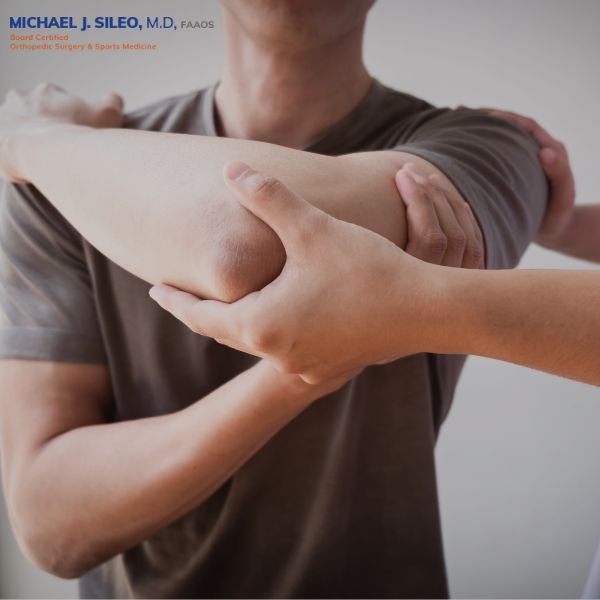
Aggressive end-range stretching. The single most common mistake is having a partner push the arm overhead, or hanging body weight from a doorframe to force elevation. During the freezing stage the capsule is actively inflamed, and stretching into sharp pain drives more inflammation, which drives more contracture. The “no pain, no gain” instinct is exactly backwards here.
Instead: pendulum swings, letting the arm hang and circle passively with gravity doing the work, then gentle assisted range of motion to the point of mild stretch and no further, held 20–30 seconds.
Forced internal rotation behind the back. The towel stretch — one hand over the shoulder, one behind the back, pulling hard — is a standard rehab exercise that patients routinely take too far. Internal rotation is usually the first motion lost in adhesive capsulitis, and yanking on it produces a sharp, lingering ache rather than progress.
Instead: slide the hand up the small of the back under its own power, stopping at first resistance. Progress happens in centimeters over weeks, not in a single session.
Ballistic and kipping movements. Kettlebell snatches, kipping pull-ups, and high-volume freestyle swimming all drive the shoulder to end range fast and repeatedly. Speed removes the ability to stop at the point where the capsule complains. This is the same principle that makes momentum-driven exercise a problem in most shoulder injuries involving the cuff or capsule.
Instead: slow, controlled table slides and wall walks, where the arm is supported and the pace is deliberate.
Loading the Shoulder at End Range
Heavy overhead pressing. Military press, overhead dumbbell press, and any loaded movement finishing above the head compress an already-tight capsule under load. Even at reduced weight, the end-range position is the problem, not the resistance.
Lateral raises above shoulder height. Raising the arms out to the side past 90 degrees requires the humeral head to rotate and glide within the capsule. When the capsule won’t accommodate that, the shoulder compensates by hiking the shoulder blade — training a movement pattern that outlasts the frozen shoulder itself.
Bench press, dips, and deep shoulder extension. Any movement carrying the elbows behind the plane of the body stretches the anterior capsule under load. Dips are the worst offender, and a flat bench press through full range is close behind.
Loaded external rotation at end range. Banded external rotation is useful, but taken to full outward rotation with meaningful resistance it loads the posterior capsule in exactly the position that hurts. Patients often add band tension well before their range justifies it.
Instead: isometric holds with the elbow at the side, pressing gently into a wall or against the opposite hand — these build cuff strength without moving the joint at all, which makes them tolerable in the earliest and most painful stage. Add scapular retraction and depression drills, a floor press or neutral-grip press with range capped by the floor, lateral raises stopped well below the point where the shoulder starts to shrug, and supine external rotation using a dowel held in both hands, the uninvolved arm guiding the involved one to a comfortable stop with no load.
Shutting the Shoulder Down Entirely
Prolonged immobilization. This is the mirror-image error. Sling use beyond a genuine post-operative indication, or simply avoiding the shoulder because moving it hurts, accelerates the contracture. Frozen shoulder is one of the few orthopedic conditions where doing nothing actively makes the outcome worse.
Sleeping on the affected side. Not an exercise, but it undoes a day of good rehab. Lying on the involved shoulder compresses the capsule for hours and is the most common reason patients report waking in more pain than they went to bed with.
Instead: five to ten minutes of gentle range of motion several times daily beats one long session, and beats rest by a wide margin. Sleep on the uninvolved side with a pillow supporting the affected arm in front of the body, or on the back with a folded towel under the elbow.
Why Stage Matters More Than the Exercise List
The same movement can be appropriate or harmful depending on where the shoulder is in the process. During the freezing stage, when pain dominates and range is falling, the priority is inflammation control and gentle motion. In the frozen stage, pain often settles while stiffness peaks, and more assertive stretching becomes both tolerable and useful. In the thawing stage, progressive strengthening is what restores function. Applying frozen-stage stretching to a freezing-stage shoulder is how patients end up worse after weeks of diligent effort — a pattern well documented in the standard orthopedic literature on capsular contracture.
Stiffness that has not improved after three to four months of consistent conservative care, or that arrived without any clear injury, deserves a formal assessment. It also matters to confirm the diagnosis, because a stiff, painful shoulder can be a cuff tear, an impingement, or early arthritis rather than a true capsular problem, and the treatment paths diverge sharply depending on which one it is.
Common Questions About Frozen Shoulder Exercise
Should I stretch a frozen shoulder even if it hurts?
Gentle stretching to the point of mild tension is appropriate and necessary. Stretching into sharp pain is not, and tends to increase capsular inflammation and prolong the condition. Stop at first firm resistance rather than pushing through it.
Can I keep lifting weights with adhesive capsulitis?
Most lower-body and core work can continue. Avoid overhead pressing, dips, deep bench press, and lateral raises above shoulder height. Isometric holds and limited-range pressing are usually well tolerated.
Does resting a frozen shoulder help it heal faster?
No. Unlike most shoulder injuries, prolonged immobilization worsens adhesive capsulitis by allowing the joint capsule to contract further. Short, frequent sessions of gentle range of motion produce better outcomes than rest.
How long does frozen shoulder take to resolve?
Most cases resolve over one to three years with conservative treatment. Shoulders that have not improved after three to four months of consistent therapy should be evaluated, since procedural options can substantially shorten the timeline.
When to See a Shoulder Surgeon
Dr. Michael Sileo is a dual board-certified orthopedic and sports medicine surgeon treating frozen shoulder at his East Setauket and Commack offices. For shoulders that do not respond to a full course of therapy, options include hydrodilatation, corticosteroid injection, arthroscopic capsular release, and manipulation under anesthesia. Call (631) 689-4189 or request an appointment via Klara.